
Timeline

Page 1 of 2

Mike Brown, NY Knicks, and Chemistry.

Mike Brown has the Knicks one win away from their first NBA championship in 53 years, which says a lot about winning, chemistry, and fit.

He coached plenty of LeBron James teams, including one that made the Finals and got swept. He coached Kobe Bryant near the tail end of his prime, just two seasons removed from championships four and five.

For years, Brown seemed like a good coach, but maybe not a championship coach.

But sometimes the missing piece isn’t greatness in isolation. It’s the right team, the right chemistry, and getting a group to play together.

As good as these Knicks are, nobody on this roster is prime LeBron or prime Kobe. And yet this may be the team Mike Brown wins it all with.

Not exactly an epiphany, but maybe a reminder: don’t count people out too quickly. They may just not be in the right environment yet.
Pope Leo XIV on Humanity and AI

Not even Catholic, but this new Pope is pretty awesome. He clearly has a better grasp of AI’s abilities, weaknesses, and implications than most business or political leaders.

If you haven’t read what he released about AI last week, you should. It is very fitting that he chose the name Leo XIV in honor of Pope Leo III from the late 1800s who addressed the industrialization movement of that time.

Pope Leo XIV on Safeguarding the Human Person in the Time of Artificial Intelligence

Simon Willison’s post on it covers the highlights well.

The secret to Apple Silcon is Apple, not ARM.

The MacBook Neo has caused some interesting conversations about ARM and Windows, and that Windows has failed to adopt ARM.

This point is never covered though: The MacBook Neo “iPhone chip” processor is the slowest/cheapest Apple Silicon chip ever made for a laptop but it is faster* than the fastest/most expensive non-Apple ARM chip ever made (Snapdragon X Elite).

The biggest problem with Windows-on-ARM laptops is not the software these days. It is, and has always been, because the other ARM CPUs are terrible.

I owned an OG Surface RT ARM device that Steven Sinofsky mentions in his post. It was the slowest computer at its price point for sure, and definitely slower than the current x86 laptop I had at the time. It was something you’d put up with for the long battery life. Interesting idea, terrible execution.

I have been interested in every ARM-based Surface device since, hoping they’d solve the terrible CPU situation, but they’ve never been competitve with the performance of a good AMD/Intel CPU, much less these incredible Apple Silicon designs. It doesn’t matter if the ARM is Qualcomm, Samsung, Nvidia, MediaTek… not a single one is better than x86, much less Apple Silicon.

I can’t say this enough, Apple Silicon is amazing because of Apple’s incredible CPU designs, not because ARM is inherently so good. Outside of Apple Silicon, the next best CPUs are all x86.

* Single core performance, which is what makes a computer feel responsive.

Latency of Iteration in an Agent-First World: How Process Debt Becomes Product Debt

As I adopt agent coding tools like Codex CLI and Claude Code, one of the biggest shifts I’ve noticed is the latency of iteration: the speed at which work can move through each stage from idea to shipping.

That faster loop is one of the biggest advantages of these tools, but it also exposes a mismatch with existing development processes.

Before AI agents, the process often looked like this, with each step taking at least a day:

idea → spec → backlog → sprint → code → review → fix → ship

With a more agent-first builder mindset, it starts to look more like this:

idea + spec → prototype + PR refinement → test + review → ship

The stages compress and blur together. What used to take days now happens in hours, sometimes minutes.

That creates a real mismatch with legacy processes like PRDs, Agile, and Scrum, which were built around slower cycles. In an agent-first world, process debt becomes product debt.

Don't send AI output you haven't reviewed, ever.

This point can’t be made enough. I’d generalize it to “Don’t send other people AI output of any kind that you haven’t bothered to fully review yourself”.

Don’t file pull requests with code you haven’t reviewed yourself.

If you open a PR with hundreds (or thousands) of lines of code that an agent produced for you, and you haven’t done the work to ensure that code is functional yourself, you are delegating the actual work to other people.

They could have prompted an agent themselves. What value are you even providing?

https://simonwillison.net/guides/agentic-engineering-patterns/anti-patterns/

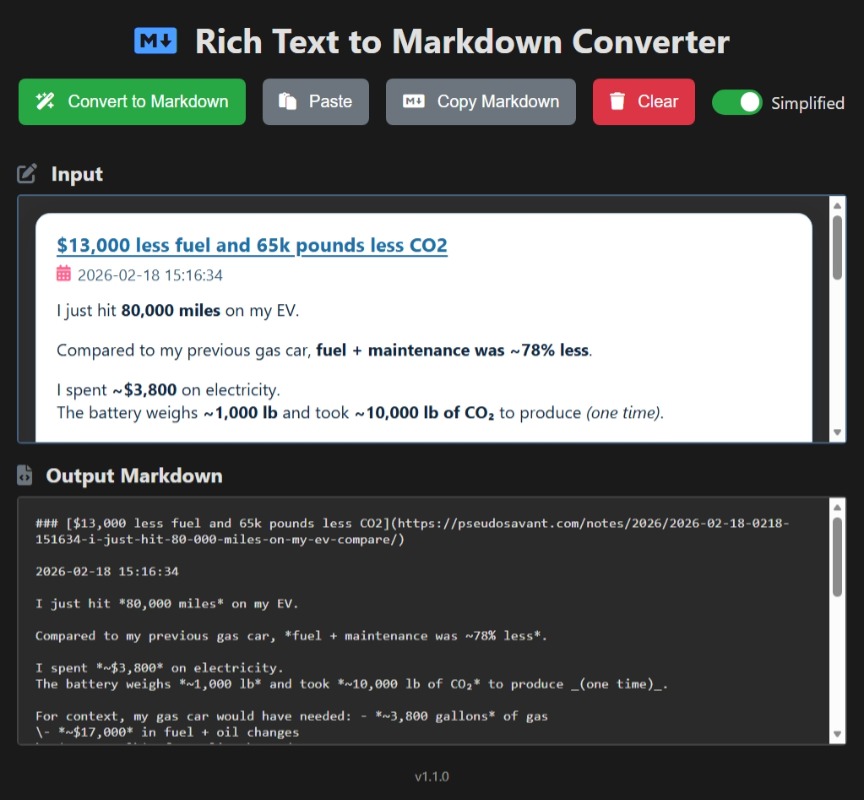
to-markdown tool: don't settle for plain text copy/paste

One thing I find myself doing a lot when working with LLMs and agents is copy context from other places into text. The problem is that information gets lost if the text has any meaningful formatting to it (tables, lists, links, etc).

I vibe coded a tool I use constantly: it converts your clibpoard into Markdown that it copies back into the clibpard. Give it a try! https://pseudosavant.github.io/ps-web-tools/to-markdown/

to-markdown-screenshot.jpeg

If You Like It, You Should Put a git on It

One thing I’ve learned working with AI on Markdown: everything belongs in a git repo. Diffs make it instantly clear what the agent changed, and keeping the file open in VS Code makes review and tweaks effortless.

AI is an exoskeleton, not a coworker

I keep noticing the same pattern: companies that treat AI as an autonomous agent that should “just figure it out” tend to be disappointed. Meanwhile, companies that treat AI as an extension of their existing workforce, an amplifier of human capability rather than a replacement, are seeing genuinely transformative results.


Don’t ask “can AI do a developer’s job?” Ask “what are the 47 things a developer does in a given week, and which of those can be amplified?”

Stop Thinking of AI as a Coworker. It’s an Exoskeleton. by Ben Gregory

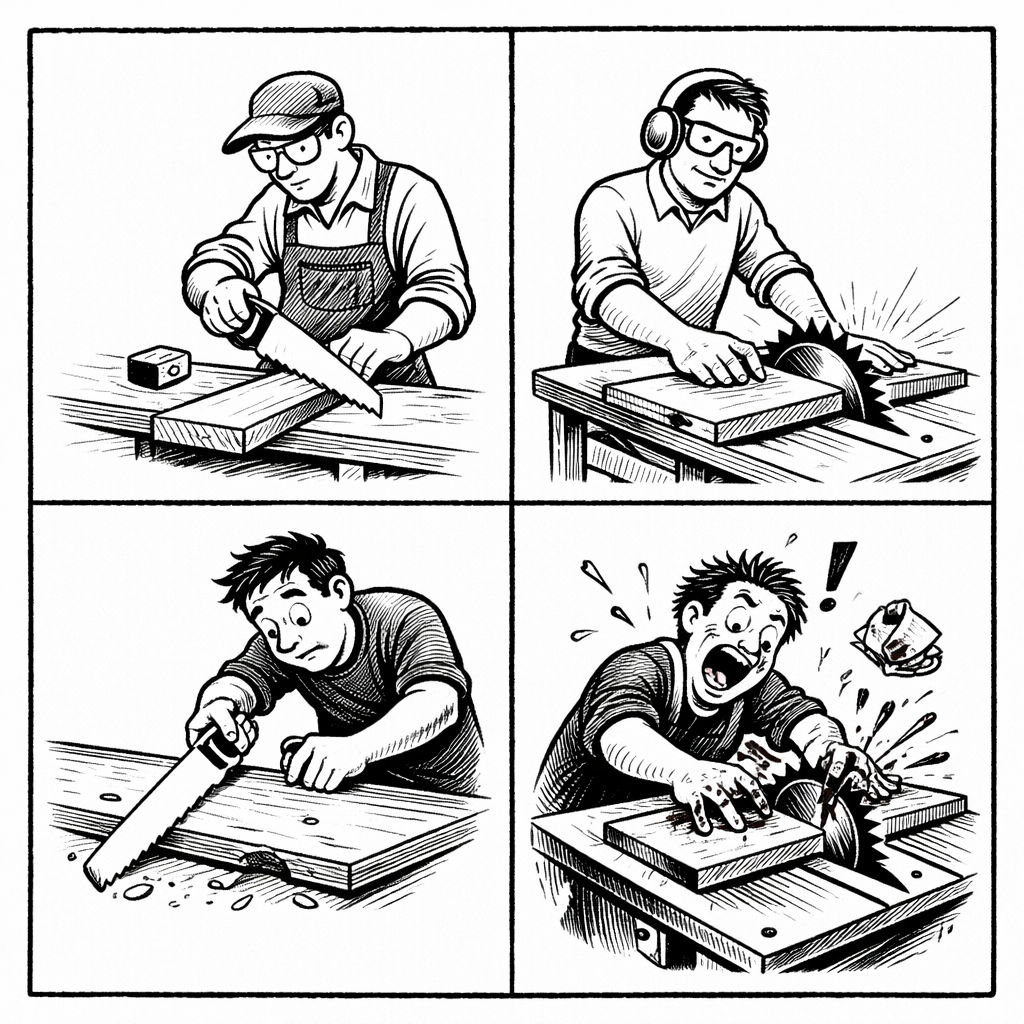
When Speed Cuts Both Ways

A table saw doesn’t make you a better carpenter. It makes you faster - for better or worse.

LLMs and agents work the same way. They’re power tools. Skill and judgment determine whether you build more, or lose fingers faster.

ChatGPT Image Feb 19, 2026, 11_18_33 AM.png

$13,000 less fuel and 65k pounds less CO2

I just hit 80,000 miles on my EV.

Compared to my previous gas car, fuel + maintenance was ~78% less.

I spent ~$3,800 on electricity.
The battery weighs ~1,000 lb and took ~10,000 lb of CO₂ to produce (one time).

For context, my gas car would have needed: - ~3,800 gallons of gas
- ~$17,000 in fuel + oil changes
- ~24,000 lb of gasoline burned
- ~75,000 lb of CO₂ emitted

Net: I saved ~$13,000 and ~65,000 lb of CO₂.